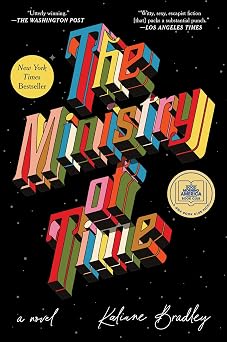
Of all the books I’ve read this year, The Ministry of Time is probably the best one that I very nearly gave up on. It’s a book about identity, on many different levels. It’s also a reflection on potential and possibilities: which of our choices end up defining us, and who we might be if we could make different ones – both as individuals, and as a society.
That’s what I appreciate most about it, and if I’m thinking about the book a few days or a few weeks from now, that’s what I’ll be dwelling on. But of course The Ministry of Time is a novel, not an essay, so all these ideas are teased out as a story unfolds. And it’s that story that for the greater part of the book failed to hook me.
It starts out with a bang, for sure: the narrator is introduced as a civilian employee of an MI5-esque cabinet agency tasked with handling a mysterious time-travel technology, and before the first chapter even wraps, a handful of folks are snatched up from the last few hundred years of British history and sequestered for “evaluation and study” by said department.
But once the civilian “bridges” are assigned to their respective historical expats, the focus quickly tightens down to the slow-burn, will-they-or-won’t-they romance between Graham Gore, 19th century naval officer, and the narrator, his 21st century handler. The characters are nuanced and well fleshed-out, so no complaints there. And the contrast between 19th and 21st century social mores – not to mention attitudes about race, imperial power, and civilization in general – provide plenty of opportunities to take a look at what’s meaningfully changed over the last 200 years, and what prejudices we’re just better at papering over these days.
Other than the social commentary, though, it’s page after page of “he pulls out my chair for me at the restaurant, but he won’t ever touch me,” “I realized he might be flirting with her; the thought gave me indigestion,” “he looks so hot in motorcycle leathers,” etc. etc. Believe me, I get that there’s a romance angle and I’m here for it – as a *component* of the story. But surely it’s not the whole story? I mean… secret time travel agency, right? I think it’s fair to expect a little more Slow Horses at the halfway mark, sprinkled in between pages of Bridget Jones’s Diary.
At this point I seriously considered just shelving The Ministry of Time due to lack of interest. I had a bunch of questions that I was still curious about: why grab these folks out of the past at all? And why assign them civilian babysitters? What’s the Ministry _really_ up to here? But I was beginning to despair of ever getting any answers.
I did push through, of course, or I wouldn’t be writing this review. And there’s a definite inflection point where the romance suddenly gets pinned to the back seat as the sci-fi conspiracy plot starts shooting out of a firehose. I think maybe it all balances out in the end, but boy is it inconsistent.
If there is a thread that ties the whole thing together, it’s that On Earth We’re Briefly Gorgeous tonality and introspection around race, sexuality, and cultural heritage. Sci-fi premise aside, that’s probably the closest literary cousin I can think of. Both books are framed as letters written by a nameless narrator who invites autobiographical speculation, and both explore the impact of war atrocities and forced migration on personal identity (although it’s much more muted in The Ministry of Time, the specter is still there). If this book had managed to smoothly weave that perspective together with the romance and the espionage? Wow. I’d be gushing.
Instead, I’m juggling an awkward mix of moved, bored, and disoriented. If you’re looking for a main course of literary or historical romance with a healthy side of identity-driven introspection, I’d say The Ministry of Time delivers. But based on the blurbs I’d seen (including those on the book jacket), I went in expecting an intriguing tale of espionage and time-travel, fleshed out with deeper nuances of social commentary and a side of romance. In that context, both the pacing and plot development turned out to be seriously disappointing.
Leave a Reply