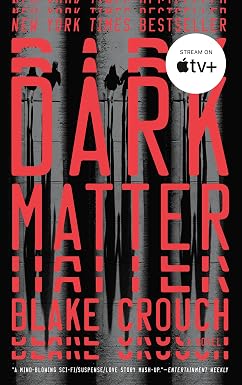
A couple of years ago I read Blake Crouch’s Recursion and really enjoyed it. It’s a solid semi-apocalyptic thriller that doesn’t telegraph its ending – it’d be a bit glib (but probably fair) to style Recursion as Inception meets Minority Report with a dash of Memento thrown in. Good stuff. Now, according to the Many Worlds Interpretation of quantum mechanics, there’s an alternate reality that’s nearly identical to this one, but in which I actually read Dark Matter first. I bet in that world I’d give it a higher rating. In this world, I’m not a big fan.
Here’s the thing: these two books share a lot of the same DNA. Without spoiling anything, it’s safe to say that they both hitch their wagons to the Many Worlds Interpretation and then invent some, ah, “highly speculative” breakthroughs around the notion of what it means for the human mind to be an observer in that system, allowing a properly prepared subject to consciously shunt themselves (or others) into a particular alternate reality.
There are a few other similarities, too – once that plot device is established, both books have their heroes do a bit of world hopping trying to fix things, and both introduce a world-spanning romance that serves as an important stake in the ground for what is ultimately acceptable as a “fix.” (And if you’re thinking about these not just as novels but as optionable screenplays, that makes a ton of sense – you definitely want to have that romance angle in the movie version!)
The biggest difference between Dark Matter and Recursion lies in the execution of their shared premise. Recursion opens as a mystery and carefully drops just enough clues to let the reader stay maybe a half-step ahead of the reveal when it finally comes. Dark Matter, on the other hand, feels obvious and predictable from the drop. You know those horror flicks where everyone in the audience knows exactly what’s happening and is yelling at the screen, vainly trying to warn the clueless kids about to get offed? This book is that movie, and my metaphorical throat was raw well before I hit the 100-page mark.
It’s a very fair question whether or not everything would have seemed so infuriatingly predictable if I’d never read Recursion. Although I obviously can’t say for sure, I think the answer is “yes.” (But I probably would have been more forgiving about it, since the plot device itself at least wouldn’t have felt like such a retread.)
Even if the jacket blurb didn’t already scream, “Dark Matter is […] about choices, paths not taken, and how far we’ll go to claim the lives we dream of,” the very first chapter works overtime to explicitly frame it that way. A major award is presented, and the recipient tells a friend, “I always thought it would be you… what happened?” A couple is cooking dinner at home, reflecting on how happy they are, but also what they’ve given up to make it work. Would they do it all over again? With that kind of setup, it’s not a big stretch to expect that we’ll revisit those inflection points again once reality becomes a bit more fluid. Sure enough, we do, and we get to see the flip side of every coin. So… surprise?
I see from the updated book jacket on Amazon that Dark Matter has already been adapted as a series on Apple TV. That tracks, and I think it’ll make a decent sci-fi show. Maybe stretching things out to span multiple seasons will make room for a few more detours or subplots that aren’t relentlessly foreshadowed. And even if not, it might land differently watching everything play out on screen without any interior dialog? As far as the printed page goes, though, if I pick up another title by Blake Crouch I’m gonna make darn sure there’s no time travel, dimension hopping, or alternate realities involved before I crack the cover open.
Leave a Reply